
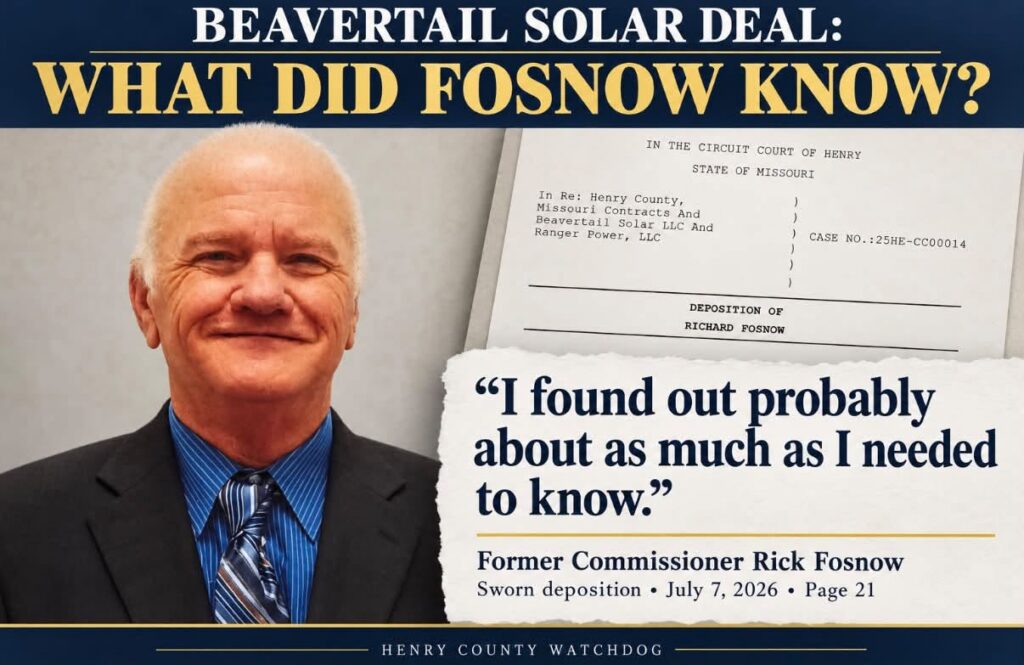
The Watchdog has obtained former Commissioner Rick Fosnow’s sworn deposition, raising questions about his review and understanding of the Beavertail solar agreement.
HENRY COUNTY, Mo. — Former Henry County Commissioner Richard “Rick” Fosnow said he believed the Beavertail solar agreement was in the county’s best interest. But his sworn testimony raises serious questions about the depth of his personal review before supporting a financial arrangement he described as lasting 25 years.
During a July 7, 2026, deposition in litigation concerning Henry County’s agreements involving Beavertail Solar and Ranger Power, Fosnow could not explain a tax-abatement percentage described in meeting minutes, could not identify who benefited from a stated $15 million difference in projected taxes, and acknowledged that he had not personally considered the possibility of the company defaulting.
Some answers concerned events he could no longer remember. Others described research he said he chose not to pursue.
That distinction matters.
Fosnow testified that he had suffered a serious heat stroke approximately two years earlier and had experienced memory loss. He also agreed with Beavertail’s attorney that he understood the transaction when it was approved, even though details were no longer readily available in his memory. His difficulty recalling information in 2026 does not, by itself, establish what he knew in 2024. (Pages 47–48.)
Nevertheless, his descriptions of his own preparation warrant scrutiny.
HOW MUCH RESEARCH WAS ENOUGH?
Asked about seeking information beyond the county’s legal advisers, Fosnow described looking at solar developments on his smartphone. He recalled pictures showing grass growing beneath panels and sites that appeared well maintained. (Page 17.)
When asked whether he felt the need to investigate further, he answered:
“No.”
Asked why, he said:
“Because I didn’t think it’d do any good. I found out probably about as much as I needed to know.” (Page 21.)
He said he neither visited nor called the out-of-state solar operation he described.
“No, I don’t — I don’t have the time to do it,” he testified.
He also could not firmly identify whether that operation was in Indiana or Illinois. (Page 22.)
Fosnow did describe receiving explanations from attorneys and discussing the project over an extended period. His smartphone research was therefore not his only source of information.
But his statement that further investigation would not do any good raises a basic question about his approach: What information was sufficient to evaluate the county’s financial interests, beyond seeing that another solar operation appeared to be functioning?
A TAX SAVINGS FIGURE HE COULD NOT EXPLAIN
One of the most consequential exchanges concerned the financial comparison presented during the November 19, 2024, public hearing.
An attorney read from minutes describing a presentation by Sarah Granath of Gilmore & Bell. According to the passage read into the deposition, the Chapter 100 arrangement amounted to a 30 percent abatement.
Asked what that meant to him, Fosnow answered:
“I don’t understand it.” (Page 35.)
The attorney then described projected taxes of $55 million without the plan and $40 million with it.
Fosnow responded:
“Somebody saved 15 million somewhere along the line.”
Asked who that somebody would be, he answered:
“I’m not sure.” (Page 36.)
Those figures were presented during questioning from the hearing record. This deposition alone does not independently establish their accuracy or prove that local taxing entities ultimately lost $15 million.
The exchange does, however, show that Fosnow could not explain the beneficiary of the financial difference being presented to him.
For an official who supported the arrangement, that is a significant gap in his ability to explain the decision.
WHAT DID THE COUNTY GIVE UP?
Near the deposition’s conclusion, Fosnow was asked what the county gave up in exchange for the $1.2 million payment discussed throughout his testimony.
“Nothing that I know of,” he answered. (Pages 52–53.)
When questioned further, he said:
“I — I don’t — I don’t think county give up anything.”
He then explained his understanding that, if the state imposed taxes on solar panels, Chapter 100 would mean Beavertail would not have to pay that personal property tax because it was already paying $1.2 million annually. (Page 54.)
Earlier, he had similarly described the company’s desire to avoid such taxes. Asked where he learned that explanation, he answered:
“Just hearing people talk.”
He identified those people as people around the county. (Page 32.)
The issue is not simply whether Fosnow could recite technical language. It is whether he could explain the central financial tradeoff: what the agreement secured for local taxing entities, what tax treatment it provided the company, and how that compared with proceeding without the agreement.
His testimony did not provide a clear comparison.
DEFAULT RISK WAS NOT SOMETHING HE PERSONALLY CONSIDERED
Asked whether he considered the possibility of Beavertail defaulting, Fosnow answered:
“Personally, no,” explaining that the company already had other solar operations running. (Pages 29–30.)
Asked whether he worried about the company being unable to pay, he again answered no.
He said he knew the function of a guarantor but, when asked to explain it, answered:
“No.” (Page 30.)
This testimony does not establish that the contracts lacked financial protections or that the county’s attorneys failed to evaluate them. It establishes that Fosnow did not describe a personal assessment of default risk and could not explain a protection raised during questioning.
Relying on professional advice can be reasonable. Residents can still expect an elected decision-maker to explain the basic risks and safeguards behind an agreement he supports.
HOW WERE PUBLIC OBJECTIONS WEIGHED?
Fosnow’s testimony also raises questions about how he evaluated public opposition.
Asked whether he “fairly and duly” considered all comments at the November 19 hearing, he answered:
“Part of them. Part of them were just screaming and calling me. I kind of looked at the source it was coming from.” (Pages 39–40.)
He described the hearing as contentious and said people shouted over those trying to explain the proposal. That is his account; the deposition alone does not independently establish how each participant behaved.
He also attributed opposition to people who lacked land to lease and therefore were not benefiting financially. (Pages 36–37, 46.)
Those were his characterizations of their motives, not established findings about why residents opposed the agreement.
Fosnow said he had “already kind of knew” what he would do. However, when specifically asked whether he entered the November 19 hearing having decided to vote yes, he denied that and described his position going into the hearing as “50/50.” Both parts of that exchange matter. (Page 40.)
FOSNOW’S DEFENSE
Fosnow consistently maintained that he intended to help Henry County.
He recalled an annual payment of $1.2 million, a 2 percent yearly increase, and a 25-year term. He believed the arrangement would particularly benefit the Davis community and its school. (Pages 41, 43–44.)
He also emphasized private-property rights and his belief that the solar development would proceed regardless of whether the county approved Chapter 100.
“We talked about it quite a while and talked to lawyers and took advice from them and everything,” he testified, explaining that the commissioners believed they had made the best available decision for the county.
He denied acting out of spite or greed. (Pages 50–51.)
Those statements deserve consideration alongside the answers that raise concerns.
The deposition does not establish dishonesty or personal enrichment. Nor does it justify treating a reported medical problem as proof of incompetence.
It does provide grounds to question whether Fosnow’s personal investigation and understanding were sufficient for the decision he helped make.
His most revealing statement may be the one about why he stopped researching: “I found out probably about as much as I needed to know.”
For residents affected by a 25-year arrangement, the question is whether that was enough.
By Michael Rosiere
Henry County, Missouri Watchdog
When Local News Falls Short, the Watchdog Steps In
Source: Deposition of Richard Fosnow, July 7, 2026, Case No. 25HE-CC00014. Page references identify the transcript’s printed page numbers. This article examines his testimony; it does not report a judicial finding of wrongdoing.