

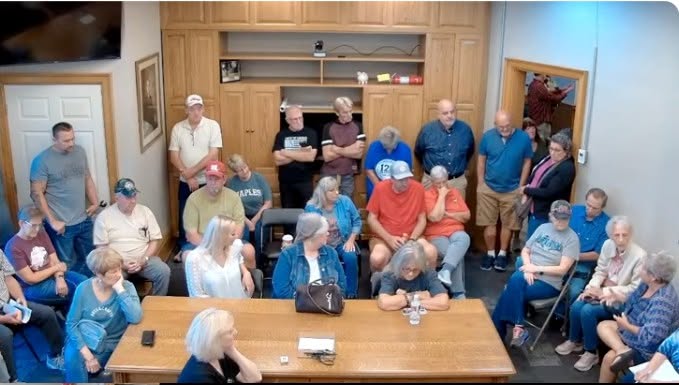
Two weeks after commissioners debated narrowing the senior tax freeze, residents returned seeking answers—and assurances that their relief would remain and to make their voices heard.
By Michael Rosiere
Henry County Missouri Watchdog
September 29, 2026
HENRY COUNTY, Mo. — Two weeks after Southside Commissioner Jake Bradley advocated removing debt-service levies from Henry County’s senior property tax freeze, he told residents Tuesday that he had changed his position and wanted to preserve the existing relief.
The announcement came during a sometimes contentious discussion among commissioners, residents and school representatives about senior finances, school funding and the future of the county’s tax-credit program.
The amendment read aloud focused on two administrative changes: eliminating annual renewal applications for previously approved taxpayers and protecting continued eligibility when certain deed or title changes occur.
The previously discussed exclusion of school debt-service levies was left out. The existing 2024 base-year provision also remained unchanged under the language presented.
For residents concerned about losing part of their anticipated relief, that represented a significant change in direction from the September 15 meeting.
HOW WE GOT HERE
As the Watchdog reported September 15, Bradley had argued that debt-service levies should be removed from the freeze because he believed the county does not directly control the money collected by other taxing entities.
“I don’t feel we have any control of that money,” Bradley said during that meeting. “And if we ain’t got control of it, we shouldn’t be the ones trying to freeze it.”
When asked whether removing debt-service levies would take existing relief away from seniors, Bradley acknowledged that it would.
“I don’t want to, but yeah,” he responded.
Northside Commissioner Mark Larson opposed narrowing the freeze. His position was that Missouri lawmakers had authorized counties to implement the program and that any challenge to that authority should be resolved in court rather than through a preemptive reduction in benefits.
“First and foremost, this was written to help the seniors,” Larson said September 15.
Michael Rosiere, who attended both meetings, questioned why Bradley’s argument about county authority would apply to school debt-service taxes but not school operating taxes. Another point of debate was the law’s specific exclusion of the Blind Pension Fund levy, which Rosiere pointed out that showed lawmakers knew how to identify taxes they wanted excluded. That point was impactful in the discussion.
The September 15 discussion also distinguished between school officials’ concerns and Bradley’s proposed response. Although Clinton school officials had approached the commission about the freeze, participants said no taxing entity had specifically requested the debt-service exclusion being debated. Bradley had stated in the September 15 meeting his proposal to exclude the debt-service levy was to be a compromise over the concerns raised by Clinton Superintendent Brungardt during his June 2 appearance before the commission.
Bradley also acknowledged during that meeting that two attorneys consulted on the issue had recommended leaving the ordinance unchanged.
Presiding Commissioner Jim Stone raised broader concerns about the program’s effect on taxing entities and younger taxpayers.
By the end of September 15, commissioners agreed on retaining 2024 as the base year, but the debt-service question remained unresolved.
No final vote was taken that day.
BRADLEY CHANGES HIS POSITION
At Tuesday’s meeting, residents quickly asked whether the school debt-service provision was still being considered for removal.
Commissioners said that part of the existing program had been left alone.
Pressed about his reversal, Bradley said he had committed to providing seniors with as much savings as possible and wanted to stay with the original approach.
Residents welcomed retaining the relief but questioned what would prevent another change of position.
Some asked whether commissioners could make the protections permanent or place the issue before voters. The discussion did not establish an irrevocable guarantee. Participants acknowledged that future amendments, changes in state law or court decisions could affect the program.
The immediate proposal was to preserve the current relief—not to establish that no future commission could ever revisit it.
The reversal followed the Watchdog’s September 15 reporting on the proposed reduction in senior tax relief and a community response that brought more than three dozen concerned citizens to Tuesday’s meeting. Residents questioned the proposal and urged commissioners to preserve the existing protections. While Bradley attributed his decision to his commitment to maximize seniors’ savings, the sequence illustrates the importance of public reporting and community participation: a proposal brought to wider public attention was reconsidered, and the relief residents came to defend remained intact.
WHAT THE AMENDMENT WOULD CHANGE
The amendment read aloud would eliminate the requirement that previously approved taxpayers submit a new application every year simply to continue receiving the credit.
Taxpayers would still have to meet eligibility requirements. The county collector could request reasonable documentation when necessary to verify eligibility, and taxpayers would remain responsible for reporting changes that cause them to no longer qualify.
The second principal change concerned deeds and recorded ownership.
Under the proposed language, a deed or title change would not, by itself, end the credit when the eligible taxpayer retains a qualifying ownership, legal or equitable interest and continues occupying the home as a primary residence.
The amendment specifically addressed qualifying changes associated with trusts, estate planning, divorce and similar circumstances.
Other provisions would remain unchanged, including the 2024 base year for taxpayers who qualified in 2024 and first applied in 2025.
SCHOOL REPRESENTATIVES QUESTION IMPLEMENTATION
Superintendent Dan Brungardt speaking for the Clinton school district said the school board was not opposed to the senior tax freeze itself.
Instead, he described concerns about using 2024 rather than 2025 as the base year and about adjustments involving revenue the district had already budgeted.
He also discussed teacher recruitment, training and other district programs in response to criticism of school spending.
That prompted a distinction central to the debate: operating revenue and debt-service revenue serve different purposes.
Michael Rosiere challenged the relevance of teacher and program expenses to the proposed debt-service exclusion, pointing out that debt-service money cannot fund those operating expenses.
The district representative Superintendent Dan Brungardt responded that his earlier request concerned operating revenue, rather than a request to exclude debt-service taxes but that is not what Commissioner Bradley was proposing two weeks earlier. He also defended maintaining debt-service reserves, explaining that those funds can help a district meet its obligations during financial fluctuations and potentially avoid increasing the levy when taxpayers are already struggling.
The Lakeland superintendent raised similar concerns about debt obligations and future levy calculations. She also said her district had experienced losses in grant funding, challenging suggestions that schools could readily replace revenue by applying for additional grants.
School representatives warned that required debt payments would remain even when eligible taxpayers receive relief, potentially placing additional pressure on other taxpayers.
SENIORS EXPLAIN WHAT IS AT STAKE
Residents repeatedly brought the discussion back to the financial realities of retirement.
Seniors in attendance described rising expenses, health limitations, medical costs and responsibilities for grandchildren or older relatives.
Several emphasized that increasing their income through another job was not a realistic option.
Others challenged the suggestion that senior relief meant seniors would no longer contribute to schools or county services. They pointed out that they would continue paying property taxes while receiving protection against qualifying increases.
For those residents, the issue was whether they could maintain some financial stability after years of paying into the same public institutions now raising concerns about the freeze.
Some thanked commissioners for preserving the existing provisions. Others expressed frustration that benefits they believed had already been settled were being reconsidered.
THE DISCUSSION TURNS TO JOBS AND COMMUNICATION
The meeting also revealed an area of common concern: Henry County’s need for more businesses and better-paying jobs.
Participants argued that expanding the tax base would help fund schools and public services without repeatedly seeking more money from the same residents.
The discussion connected school enrollment, employment opportunities and the future of smaller communities throughout the county.
Residents also questioned whether important county information was reaching the people affected by it.
Several noted that seniors who do not use Facebook, have limited mobility or cannot attend meetings may never learn about proposed changes until after decisions are made.
Suggestions included stronger public communication and more direct sharing of information with neighbors.
WHERE THINGS STAND
Bradley no longer advocated the debt-service exclusion, and the amendment presented retained the existing relief while addressing renewal applications and qualifying deed changes.
The Watchdog has verified that the amendment read aloud during the September 29 meeting was adopted unanimously, with Commissioners Jim Stone, Jake Bradley and Mark Larson all voting in favor.
The adopted amendment preserves the existing senior tax relief, including debt-service coverage and the 2024 base-year provision, while eliminating annual renewal applications for approved taxpayers and protecting continued eligibility through qualifying deed or title changes.
For now, commissioners have stated their intention to preserve the relief residents came to defend.
Resident Kevin Sullivan also pressed Brungardt to clarify whether a potential legal challenge was being discussed.
“You said there was a chance of legislation. Did you mean to say litigation?” Sullivan asked.
“It could be both, but literally even if there’s litigation, they still have to change the amendment,” Brungardt responded.
Sullivan then addressed the possibility of a lawsuit putting pressure on commissioners to change the program.
“So there’s potential that litigation could come forward and put pressure on the commission,” he said. “I would want the commission to know that if that happens, some of the folks in this room will put the pressure on the other way. Okay? Remember that.”
His comments conveyed that residents defending the existing tax relief intended to remain involved if further efforts were made to change it.
Michael Rosiere pressed Clinton Superintendent Dan Brungardt on whether the school board intended to continue pursuing a change to the 2024 base year, with litigation among the possibilities discussed.
“Is the school district going to sue? At this point in time, there is no intention to sue,” Brungardt said.
He added that the decision rests with the school board, rather than with him personally. Brungardt maintained that the board supported senior tax relief but believed the program should have used 2025 instead of 2024 as its base year.
Henry County Missouri Watchdog
When Local News Falls Short, The Watchdog Steps In
EDITOR’S NOTE: This article draws on the Watchdog’s September 15 reporting and a transcript of the September 29 meeting. September 15 quotations are reproduced from that earlier report; Competing claims concerning legal authority, school finances and potential tax effects are attributed to meeting participants and have not been independently verified for this article.