

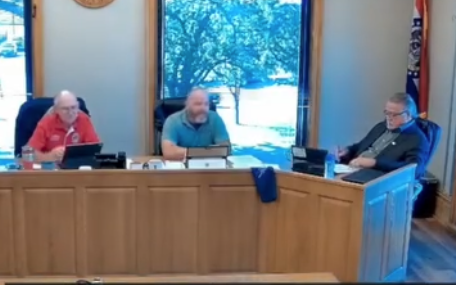
Debt-service levies become the center of a lengthy discussion as commissioners weigh whether to amend the county ordinance.
HENRY COUNTY, Mo. — What began as a discussion over amendments to Henry County’s senior property tax freeze turned into a lengthy and at times contentious debate Tuesday morning, as commissioners wrestled with whether debt-service levies — including those belonging to local school districts — should remain included in the freeze.
No final decision was made.
At the center of the discussion was Southside Commissioner Jake Bradley’s position that debt-service levies should be removed from the county’s senior tax freeze. For residents within the Clinton School District, the debt-service levy can represent a substantial portion of the school taxes appearing on their property tax bill.
Bradley repeatedly said his concern was not opposition to providing tax relief to senior citizens, but whether county commissioners should be freezing taxes belonging to separate taxing entities over which the county does not otherwise exercise direct control.
“I don’t feel we have any control of that money,” Bradley said. “And if we ain’t got control of it, we shouldn’t be the ones trying to freeze it.”
That position was challenged throughout the meeting by Northside Commissioner Mark Larson and members of the public, who argued that Missouri lawmakers gave county commissions the authority to implement the senior tax freeze.
The discussion revealed a fundamental disagreement among the commissioners: Should Henry County continue applying the freeze as currently implemented and allow the courts to resolve any future legal challenge, or should commissioners change the ordinance now because of concerns that a legal problem could arise later?
BRADLEY: “I’M GOING ON THE SIDE OF CAUTION”
“I still want the seniors to have a savings,” he said.
However, when asked whether removing the debt-service portion of the freeze would effectively take substantial existing relief away from seniors, Bradley acknowledged that it would.
“I don’t want to, but yeah,” Bradley responded.
Bradley also acknowledged that he had campaigned in support of the senior tax freeze.
“We all make mistakes, and I feel we made a mistake by adding that on there,” Bradley said while discussing the debt-service provision. “I don’t think we have the right to do that.”
LARSON FAVORS LEAVING THE BROADER FREEZE IN PLACE
Larson took a different approach.
His position was that the state enacted the law and gave counties the authority to implement it. If there is ultimately a constitutional problem (in which he believes there is no constitutional problem) with that authority, Larson argued, the courts can resolve it if challenged as any law can be challenged.
“First and foremost, this was written to help the seniors,” Larson said.
“The state wrote this, they gave us the ability to do this, then we do this and let the courts work it out,” Larson said.
That became one of the clearest dividing lines of the discussion.
Bradley’s approach was to modify the ordinance before a possible legal challenge develops.
Larson’s approach was to leave the broader freeze intact the way the state legislators wrote it unless a court determines the county lacks the authority to do so.
WHY REMOVE ONE SCHOOL LEVY BUT NOT ANOTHER?
A significant portion of the discussion centered on a question raised by Michael Rosiere regarding the distinction between a school district’s operational levy and its debt-service levy.
Rosiere questioned why Bradley’s reasoning for removing the debt-service levy would not also apply to the operational levy. (Rosiere is opposed to removing either levies from the tax exemption)
Bradley initially maintained that the two were different, but during the exchange acknowledged the difficulty in reconciling that distinction with his broader argument that the county should not control taxes belonging to another taxing entity.
“You got me there. You got me,” Bradley responded.
Later, participants discussed exactly which levies the freeze covered.
Bradley then made a significant statement about his own understanding of the scope of the freeze:
“For some odd reason I thought we were just freezing the two that we have control [of],” Bradley said.
The statement came despite Bradley having previously voted to enact the senior tax freeze and raised questions during the meeting about whether he fully understood which taxing levies were included when the measure was originally approved.
The discussion then turned to whether maintaining the existing broader freeze and allowing a court to resolve the legal issue if it is ever challenged might be the cleaner approach.
Blind Pension Levy Becomes Key Point in Debate
Another significant point in the discussion came when Michael Rosiere challenged the argument that state lawmakers had failed to adequately consider which taxing entities should be included in the senior tax freeze.
Rosiere pointed to language discussed during the meeting that specifically carved out the Blind Pension Fund levy from the freeze. His argument was that the existence of a specific exemption was evidence that lawmakers had, in fact, considered whether certain levies should be excluded.
Rosiere argued that if lawmakers intended to exempt school districts, debt-service levies or other taxing entities, they had the opportunity to identify those exemptions just as they had done with the Blind Pension Fund levy.
“They specifically exempted the blind tax,” Rosiere said during the discussion, arguing that lawmakers had already demonstrated their ability to carve out a particular levy when they did not want it included.
The point drew a notable response from Bruce Dewsberry, who had previously expressed his own concerns about whether commissioners should have authority over taxes belonging to other political subdivisions.
Dewsberry acknowledged that he had not previously considered the significance of the specific exemption and said Rosiere’s argument affected his thinking on the issue.
Dewsberry’s response was significant because it shifted the discussion from whether lawmakers simply failed to consider the different taxing entities to whether the specific exemption could indicate that lawmakers deliberately chose which taxes would — and would not — be excluded.
Rosiere’s argument was essentially that the Legislature did not need to list every levy that was included if the law broadly included them and then specifically identified the levy it wanted excluded.
The exchange did not resolve the legal question, but it introduced another consideration into the commissioners’ debate: **If lawmakers specifically carved out one levy from the senior tax freeze, what does that say about the levies they chose not to exempt?**
ATTORNEYS’ ADVICE BECOMES PART OF THE DEBATE
Another significant moment came when commissioners were asked who had specifically requested that debt-service levies be removed.
The answer given during the discussion was that no taxing entity had specifically requested that particular change.
Bradley indicated his concern arose from legal advice and how this could be a compromise.
However, participants also stated that two attorneys consulted on the issue had recommended leaving the freeze alone.
Bradley acknowledged and confirmed that was the advice given by the two attorneys but said he did not agree with their recommendation to leave the ordinance unchanged.
“I was just thinking ahead and that’s why I decided that I would like to see it be eliminated because I can see there being an issue coming up with it,” Bradley said.
Bradley was also challenged over previous occasions when he had emphasized the need to follow recommendations from attorneys. He responded that he considers attorneys’ opinions but does not necessarily agree with everything they recommend.
CLINTON SCHOOL DISTRICT’S CONCERNS ENTER THE DISCUSSION
The Clinton School District became a recurring subject during the meeting.
Participants said Clinton school officials had previously approached the county regarding the senior tax freeze and its financial impact.
Bradley confirmed that Clinton school officials were the first to approach commissioners with concerns surrounding the freeze.
When asked how many other school districts had voiced concerns to commissioners, Bradley answered:
“Not a one yet”
Bradley was also unable during the discussion to identify another entity beyond Clinton school officials that had requested changes to the tax freeze.
That led to repeated questions about why the county should modify the ordinance when the concerns brought directly to commissioners had come from Clinton school officials.
Bradley pushed back strongly:
“You guys got a personal vendetta against the Clinton schools,” Bradley said.
Those participating immediately disputed that characterization, saying Clinton was being discussed because it was the school district that had approached the commission and because participants were examining its financial figures.
Bradley responded that his concern extended beyond Clinton.
“What I’m trying to throw out there is other schools will be affected,” Bradley said. “And this is going to affect the county as a whole.”
Rosiere raised another concern about the potential long-term effect of excluding debt-service levies from the freeze.
He argued that if operational levies remain subject to the senior tax freeze while debt-service levies are exempted, school districts could have an incentive to shift more of their tax burden toward debt-service levies or take on additional debt as a way of reducing the impact of the freeze.
Rosiere argued that the county should consider not only what schools are doing today, but what incentive such an exemption could create in the future.
In his view, carving debt-service levies out of the freeze could unintentionally create a pathway for taxing entities to work around some of the protections the senior tax freeze was intended to provide.
STONE QUESTIONS THE BROADER BENEFIT OF THE FREEZE
Presiding Commissioner Jim Stone also expressed concerns about the senior tax freeze more broadly.
Stone said the county should consider the effects on all taxpayers and taxing entities rather than focusing solely on one group.
At one point, Stone described the senior tax freeze as something he did not believe was ultimately beneficial to Henry County as a whole, while acknowledging that some seniors genuinely need financial assistance.
Stone also expressed concern that reducing taxes for seniors could shift additional tax burdens onto younger taxpayers.
His comments prompted questions about why he had previously voted for the freeze if he held those concerns.
Stone responded that he had expressed reservations about the program from the beginning.
SHOULD THE VOTERS DECIDE?
As the discussion continued, another possibility emerged: let Henry County voters decide.
Rosiere explained that he had previously begun gathering petition signatures to place the senior tax freeze before voters before commissioners enacted it themselves.
He said the current controversy was causing him to consider restarting that petition effort.
“I’m thinking I need to do the petition again so that we can just bypass you guys so that you can’t take it away,” Rosiere said.
That led to discussion about whether commissioners themselves could place the issue before voters instead of requiring citizens to gather petition signatures.
Another proposal came from Amanda Johnson, who suggested commissioners meet with the various taxing entities affected by the freeze before making a decision.
Johnson argued that doing so could create dialogue between the county and school districts, townships and other entities whose revenues could be affected.
Others disagreed, arguing that the Legislature gave the decision to county commissioners rather than the individual taxing districts.
2024 ROLLBACK APPEARS TO HAVE UNANIMOUS SUPPORT
Despite the disagreement over debt-service levies, the commissioners appeared to agree on one significant part of the senior tax freeze.
The freeze will use **2024 as the base year**, according to statements made during the meeting.
That point was reinforced when a senior citizen who had attempted to call earlier in the meeting was later contacted by telephone.
The caller directly questioned Bradley about his campaign support for the senior tax freeze and his current position on debt-service levies.
“I feel like your constituents want the senior tax freeze on the debt service levy for the schools and you made campaign promises that you’re not wanting to uphold now,” the caller told Bradley.
Bradley responded that he had campaigned for the senior tax freeze and continued to support it, but said there were conflicting issues involving debt service and what he believed would be best for Henry County going forward.
The caller then addressed the attorneys’ reported recommendation.
“I think the best course of action here would be let the attorneys do their job,” she said. “Commissioner, you do what the people want and what you campaigned on and let the attorneys do their job.”
Bradley responded:
“Yes, ma’am. You are right.”
When she asked whether taxes would be frozen back to 2024, Bradley said they would.
“They will be frozen back to 2024. That’s what all three of us have agreed on for sure,” Bradley said.
But when she asked whether that would continue to include the school debt-service levy, Bradley answered:
“That is still up in the air.”
NO VOTE — FOR NOW
After more than an hour of discussion spread throughout the meeting, commissioners did not take a final vote on the disputed debt-service provision.
Near the end of the meeting, Bradley was asked what would have to happen for him to change his position.
“I don’t know yet,” Bradley said. “I got to stew on it, guys. That’s my process.”
Rosiere said he believed seniors should be made aware that part of the existing freeze was under reconsideration and be given an opportunity to attend the meeting where commissioners ultimately vote.
“When I did that petition out there and stood out here, hundreds of seniors showed up,” Rosiere said. “And I’m sure if they feel like it’s threatened to be taken away, hundreds will show up.”
For now, the central question remains unresolved.
The commissioners appear to agree that the senior property tax freeze should be based on 2024 values.
What they have not agreed upon is **how much of the property tax bill should remain frozen — specifically whether increases in school and other debt-service levies should continue to be included. It is notable to point out that without the school tax levies being included in the tax freeze as allowed by the bill passed by state legislators; there will be no substantial tax relief for the Seniors of Henry County.
Bradley remains concerned about the county’s authority over taxes belonging to other entities and the possibility of future legal consequences.
Larson’s position is that the state gave counties the authority and the county should continue providing the broader freeze to bring real tax relief to the Seniors this was intended to help unless the courts say otherwise.
Stone continues to question the broader implications of the freeze and its effect on Henry County’s taxing entities and other taxpayers.
The final decision remains with the three-member Henry County Commission.
**No final vote was taken September 15.**
By Michael Rosiere
Henry County Watchdog
When Local News Falls Short, The Watchdog Steps In
*EDITOR’S NOTE: This article reports the statements, arguments and legal interpretations presented during the September 15 Henry County Commission meeting. The Henry County Watchdog has not independently analyzed or fact-checked the competing legal interpretations for this article. Statements concerning Missouri law, constitutional provisions, school finances, tax collections and legal advice are attributed to the participants who raised them.