

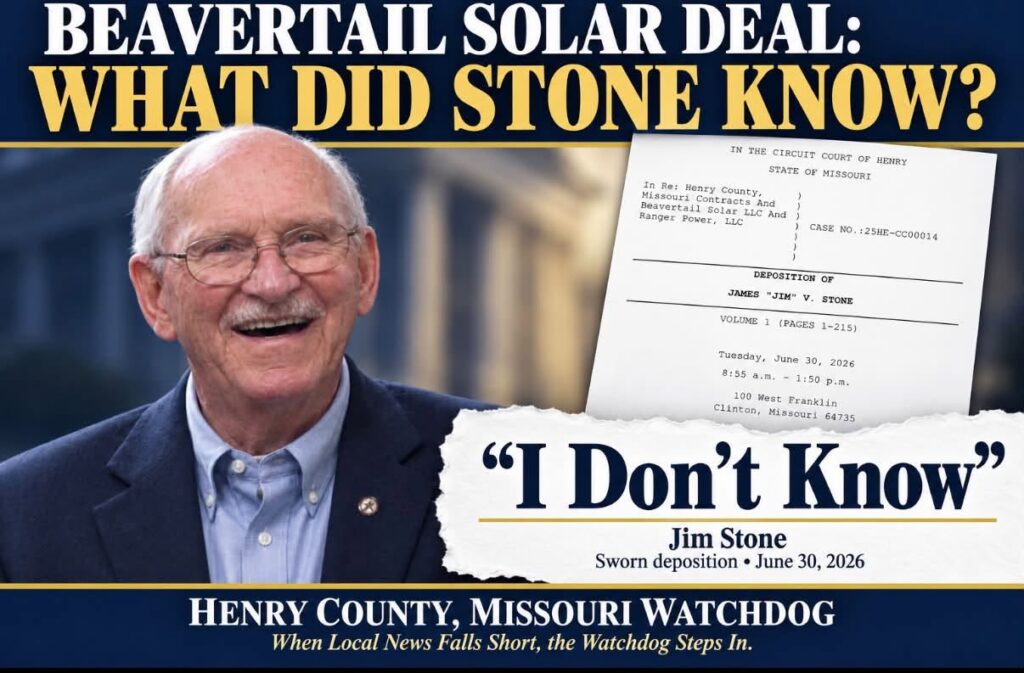
At least 85 responses indicated uncertainty, lack of knowledge, or inability to recall details about the project and its approval.
When Henry County Presiding Commissioner Jim Stone sat for a sworn deposition concerning the Beavertail Solar Chapter 100 project, his testimony provided the public with something we rarely get: An opportunity to hear, under oath, exactly what one of the commissioners who approved this massive agreement actually knew about the deal. And perhaps more importantly—what he didn’t know.
A review of the deposition found at least 85 separate responses in which Stone used language indicating uncertainty, lack of knowledge, lack of recollection, or inability to answer—including statements such as:
“I don’t know.”
“I do not know.”
“I didn’t know.”
“I don’t understand.”
“I can’t remember.”
“I don’t remember.”
“I can’t answer.”
“I can’t tell you.”
“I’d have to…”
To be fair, not every one of those statements concerned a major provision of the Chapter 100 agreement. Some involved dates, meetings, people, or other details.
But many involved subjects that should concern every Henry County taxpayer: taxes, financial comparisons, decommissioning, the $650 million in bonds, the company behind the project, land involved in the project, protections for neighboring property owners, and the actual operation of the solar facility.
Here are some of the most significant examples.
1. STONE DID NOT KNOW THE MOST IMPORTANT TAX COMPARISON
Stone was asked whether an analysis had been performed comparing what the fully developed solar facility would pay under normal taxation versus what Henry County would receive under the Chapter 100 arrangement.
Stone said an analysis had been done. But when asked what that number was, Stone answered:
“I do not know.”
He instead pointed to former County Clerk Rick Watson as the “numbers guy.”
Transcript: Pages 45–46
This is an extremely important distinction. The relevant comparison wasn’t simply what agricultural land was paying in taxes before the solar development.
The question was:
What would this $600+ million industrial solar facility have paid in property taxes WITHOUT the Chapter 100 tax abatement compared with what Henry County agreed to receive WITH the Chapter 100 deal?
When that issue was explained further, Stone said:
“I don’t understand what you’re asking there, for sure.”
After additional explanation, he said:
“I’d have to get with the people that figured it for sure.”
And ultimately:
“I’m sorry, I can’t answer.”
Transcript: Pages 47–48
That should concern taxpayers.
2. STONE DIDN’T KNOW WHO ACTUALLY OWNED RANGER POWER
Stone was questioned about the company behind the project.
Was Ranger Power publicly traded?
“That, I don’t know.”
Had Stone spoken with anyone who claimed to actually own the company?
“Nope, I can’t tell you that. I don’t know…”
Stone eventually acknowledged:
“I didn’t find that out.”
And when directly asked whether, before December 2024, he knew who actually owned Ranger Power, Stone answered:
“No.”
Transcript: Pages 76–77
Henry County was entering into an enormous long-term financial arrangement connected to this company. Yet its presiding commissioner testified that he didn’t know who actually owned it.
3. THEN CAME THE $650 MILLION QUESTION
This may be one of the most revealing portions of Stone’s deposition.
Stone was asked:
“Is it your understanding that the $650 million in bonds are going to be used to buy the solar panels?”
Stone answered:
“No.”
So the attorney asked:
“What’s your understanding of the 650 million?”
Stone responded:
“650 million is a guarantee that – the decommissioning of it, clean up…”
Stone continued explaining that if something happened, the equipment could be removed, pilings pulled and the ground returned to its previous condition.
The attorney then attempted to clarify:
“That’s what the 650 million is for?”
Stone answered:
“Yeah…”
and then added:
“…the big part was cleanup.”
Transcript: Pages 84–86
Later in the deposition, Stone was again asked why Henry County became involved when the underlying leases were private agreements between Beavertail and individual landowners.
Stone answered:
“The Chapter 100, that is for us to get paid, really, and to make sure it’s cleaned up.”
The attorney again asked:
“That’s what the 650 million was for, to make sure it gets cleaned up?”
Stone answered:
“Gets cleaned up and then make sure it’s paid.”
He then said:
“Well, to me, it – it covers the cleanup.”
Transcript: Pages 118–119
Notice Stone’s own wording:
“To me…”
This testimony raises a major question about Stone’s understanding of the $650 million bond authorization.
Was $650 million actually being placed somewhere to guarantee decommissioning? Was it financing for construction and acquisition of the project? Was the entire $650 million available for cleanup? Or was decommissioning secured through a separate mechanism?
Those questions matter because Stone repeatedly described the $650 million as being tied to cleanup and decommissioning. And he was one of the commissioners who approved it.
4. WHAT DID STONE ACTUALLY KNOW ABOUT DECOMMISSIONING AND WHO WOULD PAY?
Stone clearly testified that decommissioning was a major reason he believed the County should become involved. His concern was straightforward: What happens if the solar company eventually walks away?
Stone explained:
“If they lease that land and they go in there and put all that on there and they walked away from it and we didn’t have a dime to put it back the way it was, that’s not what our intent was.”
He continued:
“We want to party in there that it’ll be cleaned up…”
Transcript: Page 85
Later, when asked why cleanup should become a County concern when the lease was between a private landowner and Beavertail, Stone responded:
“People. Who’s going to clean up the mess?”
He said the arrangement was intended to make sure:
“land’s put back in place.”
But Stone also acknowledged limitations in what he knew about the private arrangements with landowners.
He said:
“I don’t know what they’ve made arrangements.”
And:
“I didn’t know anything about it until I found out because I was the last to know that.”
Transcript: Pages 119–120
When the attorney summarized the issue one final time—asking whether it became a County issue because the County wanted the property cleaned up—Stone answered:
“Yeah, we want it cleaned up.”
Transcript: Pages 120–121
There is another remarkable part of the decommissioning story.
The deposition discusses a November 19, 2024 County Commission meeting. According to the meeting minutes presented during the deposition, commissioners voted to approve the decommissioning agreement before the public hearing on the Chapter 100 project.
Stone acknowledged the vote.
When questioned about how that happened, Stone said:
“I don’t remember how that went down. I really can’t think exactly because it’s kind of a mess.”
He then acknowledged something else:
“I don’t follow agendas as well as I should.”
Transcript: Pages 137–141
Regardless of someone’s position on solar, that testimony deserves public scrutiny.
5. STONE HAD NEVER REVIEWED THE LAND LEASES
Stone acknowledged that he had never seen the leases between Beavertail and the participating landowners.
When asked whether he had ever requested that Beavertail provide those leases, Stone answered:
“No, don’t think so.”
Transcript: Pages 26–27
6. STONE COULD NOT STATE WITH CERTAINTY HOW LONG THE ARRANGEMENT LASTED
When asked how long the Chapter 100 program would last, Stone initially said:
“Twenty-five – 20 years or 25 years…”
He later discussed the possibility of an extension and said:
“Or 40 years, I think.”
Before acknowledging:
“That part of it, I can’t take 100 percent. I don’t have it in front of me where I can tell you the exact.”
Transcript: Page 49
For an agreement with financial consequences extending decades into the future, the length of the arrangement is not a minor detail.
7. NO INDEPENDENT SOLAR EXPERT WAS HIRED
Stone testified that the County relied upon Gilmore & Bell regarding Chapter 100.
But when asked whether Henry County hired an independent expert concerning the actual construction and maintenance of a utility-scale solar facility, his answers were straightforward.
Expert on properly constructing a solar farm?
“Nope.”
Expert on properly maintaining one?
“Nope.”
Stone then acknowledged:
“It’s not my expertise. I’m not – no use of me going there. I’m not a solar guy.”
Transcript: Pages 62–67
That raises a basic question:
If the commissioners themselves weren’t solar experts, why wasn’t an independent solar expert advising the County before such a massive agreement was approved?
8. THE COUNTY DIDN’T INVESTIGATE WHETHER OTHER SOLAR COMPANIES MIGHT BE INTERESTED
Stone was asked whether Henry County investigated whether other solar companies might be interested in the Montrose area and its existing electrical infrastructure.
His answer:
“No.”
His explanation was essentially that nobody else had approached the County.
Transcript: Pages 73–74
But that raises another question:
If Henry County possessed a valuable location with existing electrical infrastructure, shouldn’t the County have determined the market value of what it had before negotiating a decades-long incentive agreement?
9. STONE DID NOT THOROUGHLY INVESTIGATE THE SOLAR PROJECT USED AS A COMPARISON
Stone testified about flying over the Warrenton solar project, which was used in part as a guideline for Henry County.
But when asked whether he investigated the project