

⠀
He entered the public town hall hearing with his position settled. Months later, under oath, he struggled to explain the tax break, the financial comparison and much of the deal he helped approve.
⠀
This is the final article in the Watchdog’s three-part examination of the sworn depositions of Jim Stone, Rick Fosnow, and Dale Lawler concerning their roles in approving the Beavertail Solar Chapter 100 tax-abatement arrangement.
⠀
Across the three accounts, a troubling pattern emerged: commissioners who remained confident they had made the right decision struggled to explain important financial terms, tax concessions and protections for Henry County.
⠀
Their testimony raises serious questions about how thoroughly they understood the arrangement and independently evaluated the advice presented to them.
⠀
Relying on attorneys and project representatives does not relieve elected officials of responsibility for their decisions. The central question throughout this series is whether the commissioners understood enough to exercise their own informed judgment on behalf of the people they represented.
⠀
By Michael Rosiere
Henry County, Missouri Watchdog
⠀
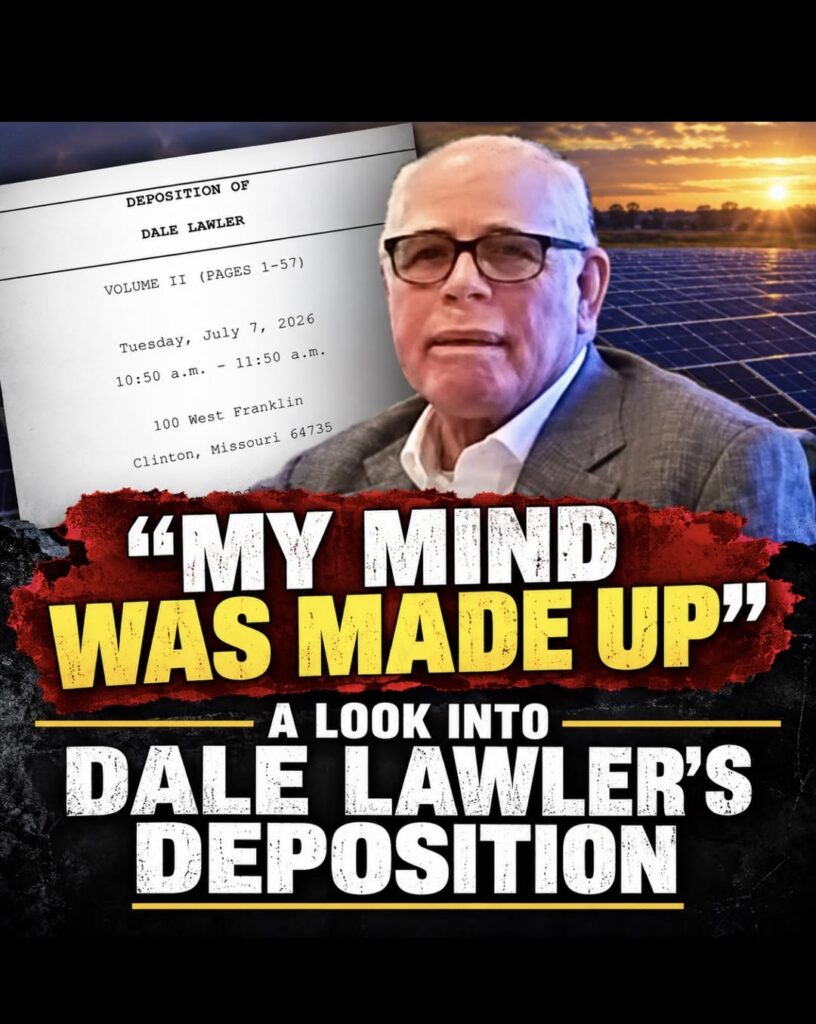
Before residents stepped forward at the public town hall hearing to support or oppose the Beavertail Solar Chapter 100 arrangement, then-Commissioner Dale Lawler had already reached his decision.
⠀
Asked under oath whether his mind was made up going into the town hall hearing, his answer was direct:
⠀
“My mind was made up, you know.”
⠀
Source: July 7, 2026 deposition, Volume II, page 30, lines 1–3.
⠀
His testimony raises many questions such as: How fully did he understand the financial arrangement he had already decided to support?
⠀
Across two depositions, Lawler said he did not believe the deal included a tax abatement, despite minutes describing one.
⠀
He struggled to distinguish the bond amount from the annual payments. And he could not consistently explain whether the negotiated payments would bring in more money than if they just allowed the solar project to be taxed at normal rates.
⠀
Despite significant gaps in his understanding revealed during sworn testimony, Lawler remained confident that he and the other two commissioners had made a good deal. His certainty about the outcome stood in sharp contrast to his difficulty explaining the arrangement they approved.
⠀
Citation note: references below identify which deposition the information was pulled from: The first deposition “March 2026, Volume I.” The second deposition is dated July 7, 2026, Volume II.
⠀
Reviewing the November 19, 2024 minutes, Lawler acknowledged that commissioners reconvened at the courthouse at 11:55 a.m. He made the motion to approve the resolution to proceed with Chapter 100. The meeting adjourned at 11:58 a.m.
⠀
Asked whether he recalled commissioners discussing points raised during the public town hall hearing, he answered:
⠀
“I do not.”
⠀
Source: July 7, 2026 deposition, Volume II, page 29, lines 2–25.
⠀
Lawler explained that he did not believe the hearing’s comments were new. Yet when asked which negative comments he had heard before, he could not recall specifics.
⠀
Instead, he offered this:
⠀
“People would complain if they were hung with a new rope. So anyway, some people are just opposed to anything.”
⠀
Source: July 7, 2026 deposition, Volume II, page 40, lines 15–25; page 41, lines 1–2.
⠀
When pressed on whether he had discounted objections as griping, Lawler said residents believed they had legitimate complaints and added, “I’m not disagreeing with them.” He argued that waiting for everyone to agree would prevent anything from getting accomplished.
⠀
Source: July 7, 2026 deposition, Volume II, page 41, lines 3–10.
⠀
But disagreement over the project was only part of the questioning. The attorney also examined what Lawler understood about the financial arrangement itself.
⠀
Shown minutes describing Beavertail’s request for a tax abatement, Lawler said:
⠀
“I don’t think there was any abatement of taxes, so I’m not really sure what that means — what that would mean for sure.”
⠀
He then repeated:
⠀
“I don’t believe that there was.”
⠀
Source: July 7, 2026 deposition, Volume II, page 26, lines 11–25; page 27, line 1.
⠀
The attorney directed him to language in the minutes describing a 30 percent abatement.
⠀
Lawler acknowledged seeing it. He could not recall discussions about that percentage, negotiations that produced it or where the number came from.
⠀
In the end, the Chapter 100 agreement entered was in fact a tax abatement agreement, something Dale Lawler showed confusion over multiple times during his depositions.
⠀
Source: July 7, 2026 deposition, Volume II, page 27, lines 2–17; page 28, lines 3–16.
⠀
During the March deposition, the attorney read a passage describing $55 million in taxes without the plan and $40 million with it.
⠀
Q. At least according to these minutes, the — if you didn’t do the Chapter 100s, there’d be 15 more million dollars paid in taxes, correct?
⠀
A. According to this statement, yes.
⠀
Q. Do you think that statement’s wrong?
⠀
A. I don’t really have an opinion on that.
⠀
Source: March 2026 deposition, Volume I, page 74, lines 1–21.
⠀
By July, that conflict remained unresolved. Lawler referred back to the $55 million and $40 million figures while continuing to question whether there was an abatement.
⠀
Source: July 7, 2026 deposition, Volume II, page 27, lines 13–25; page 28, line 1.
⠀
But the testimony establishes something important: The minutes described a tax concession that Lawler said he did not believe existed.
⠀
His answers about the financial comparison also changed.
⠀
In March, Lawler said ordinary taxes on the solar project would be “pretty small” compared with the $1.2 million payment. Asked whether he understood ordinary taxes would be less, he answered yes.
⠀
Source: March 2026 deposition, Volume I, page 58, lines 18–25; page 59, lines 1–7.
⠀
In July, after the attorney clarified that he meant taxes on the completed solar facility without Chapter 100, Lawler could not say what that amount would be or whether it would exceed the negotiated payment.
⠀
Q. Do you know if it would be more or less?
⠀
A. No, I don’t.
⠀
Source: July 7, 2026 deposition, Volume II, page 23, lines 12–23.
⠀
In March, he expressed confidence that ordinary taxes would be lower. In July, he could not say which amount would be greater.
⠀
Earlier in the July exchange, Lawler distinguished money going to the county from taxes generally. That distinction matters.
⠀
Even so, his final answers did not substantiate the financial advantage he had described in March again showing confusion and clearly demonstrating he lacked understanding in the deal he had entered into.
⠀
Source: July 7, 2026 deposition, Volume II, page 23, lines 1–23.
⠀
The same uncertainty appeared when he was asked about a cost-benefit analysis.
⠀
Lawler could identify the benefit: $1.2 million coming to local taxing entities.
⠀
Asked whether he understood the cost being measured, he answered:
⠀
“I’m not sure.”
⠀
Source: July 7, 2026 deposition, Volume II, page 22, lines 1–19.
⠀
Dale Lawler did not understand the difference between the money being paid each year with the Chapter 100 verses what regular taxes would bring in.
⠀
School funding provided another example.
⠀
Lawler cited $700,000 for the school as a reason the arrangement benefited Davis Township. But had he compared that payment with the taxes the school would receive from the solar project without Chapter 100?
⠀
“I did not.”
⠀
Source: July 7, 2026 deposition, Volume II, page 36, lines 1–17.
⠀
A payment can benefit a school while still being smaller than another available source of revenue. His testimony did not establish which alternative would produce more.
⠀
The uncertainty went beyond the revenue comparison.
⠀
In March, Lawler was asked whether he understood how Chapter 100 financing mechanically operated.
⠀
“Not really.”
⠀
Asked whether he understood who owned the project under that financing, he gave the same answer.
⠀
Source: March 2026 deposition, Volume I, page 21, lines 5–10.
⠀
When asked for the total bond amount, he initially answered $1.2 million. After the attorney mentioned $650 million, he corrected himself:
⠀
“Sorry, I — I — the bonds are 650 million, and the project dollar amount coming into the taxing entities is $1.2 million. Sorry.”
⠀
Source: March 2026 deposition, Volume I, page 28, lines 4–20.
⠀
Months later, the distinction again caused difficulty.
⠀
Asked in July for the total Chapter 100 bond amount, Lawler answered:
⠀
“$1.2 million a year, I think it is.”
⠀
Asked whether the county was issuing $650 million in bonds, he said:
⠀
“I’m not sure how that was — how that was going to work.”
⠀
Source: July 7, 2026 deposition, Volume II, page 17, lines 7–16; page 18, lines 5–15.
⠀
This was a repeated knowledge gap: He corrected the distinction in March, then struggled with it again in July. It does not establish that Henry County taxpayers personally owe $650 million.
⠀
Questions about cleanup produced a different kind of uncertainty.
⠀
In March, Lawler said the county would not pay to remove the equipment at the end of the project.
⠀
“Ranger Power is responsible for it.”
⠀
Source: March 2026 deposition, Volume I, page 49, lines 1–8.
⠀
In July, he described a bond intended to pay for removal and restoration. Asked who was paying for it, he answered:
⠀
“I’m not sure.”
⠀
Source: July 7, 2026 deposition, Volume II, page 18, lines 16–25.
⠀
What the testimony shows is that Lawler could not clearly explain the agreement he had signed.
⠀
He also had limited information about the land’s agricultural future.
⠀
Asked about a claim that soil beneath solar panels could “go dead,” he responded:
⠀
“I’ve heard a silly statement like that.”
⠀
He said he had seen no evidence supporting the claim and cited grass growing beneath panels at the Montrose Catholic church.
⠀
Source: July 7, 2026 deposition, Volume II, page 11, lines 1–19.
⠀
But he acknowledged that he had not seen a decommissioned solar site, crops grown after removal or livestock grazing a restored site. He had made no such inquiry before voting.
⠀
Source: July 7, 2026 deposition, Volume II, page 11, lines 20–24; page 12, lines 1–11.
⠀
Asked whether he considered hiring an environmental expert or solar consultant to explain the project’s risks and benefits, Lawler answered:
⠀
“No.”
⠀
Source: July 7, 2026 deposition, Volume II, page 12, lines 22–25; page 13, line 1.
⠀
His account of employment benefits was similarly limited.
⠀
In March, Lawler said he had not personally investigated the project’s potential overall economic impact.
⠀
Source: March 2026 deposition, Volume I, page 34, lines 5–8.
⠀
In July, he recalled projected full-time employment of:
⠀
“three to five or something like that, a small number.”
⠀
He could not recall comparing those jobs with agricultural employment potentially displaced.
⠀
Source: July 7, 2026 deposition, Volume II, page 21, lines 1–9.
⠀
He mentioned possible sheep-grazing and mowing opportunities. But he did not know how many mowing jobs would exist, whether they would be full time or whether local hiring was required.
⠀
Source: July 7, 2026 deposition, Volume II, page 19, lines 9–25; page 20, lines 1–22.
⠀
Lawler believed Gilmore & Bell had performed an economic analysis. He remembered seeing numbers but could not recall them.
⠀
Note: No economic impact study was ever conducted.
⠀
Source: July 7, 2026 deposition, Volume II, page 21, lines 10–24.
⠀
His answers about township opposition reveal another gap: communication.
⠀
Asked whether he investigated whether Davis Township pursued zoning to prevent the solar farm, he said:
⠀
“I’m sure that was their reason, I guess, but I didn’t vote out there, so whatever they’ve done was their business.”
⠀
Source: July 7, 2026 deposition, Volume II, page 31, lines 18–25; page 32, line 1.
⠀
He later acknowledged both townships’ votes favoring zoning and again said he had not investigated why residents voted that way.
⠀
Source: July 7, 2026 deposition, Volume II, page 35, lines 1–21.
⠀
Those were zoning votes, not direct referendums on Chapter 100. But Lawler’s testimony shows he did not investigate the concerns behind them.
⠀
Asked whether he spoke with anyone in Davis Township about why it entered a development agreement with Beavertail, he answered:
⠀
“They — they weren’t real friendly to me, so I didn’t talk to them.”
⠀
He connected that perception to his belief that township board members were involved in the lawsuit.
⠀
Source: July 7, 2026 deposition, Volume II, page 51, lines 1–12.
⠀
Throughout both depositions, Lawler defended his decision.
⠀
He cited advice from Gilmore & Bell, consultation with a Warren County commissioner and his belief that Chapter 100 protected local revenue from possible future state assessment. He also cited financial certainty for the developer and its lenders.
⠀
Source: March 2026 deposition, Volume I, page 93, lines 1–17; page 94, lines 4–19.
⠀
He later clarified that Gilmore & Bell had not told him the project was in the county’s best interest. Rather, he said, the firm explained the local-revenue rationale.
⠀
Source: March 2026 deposition, Volume I, page 97, lines 6–25.
⠀
In July, he also contrasted depreciation of taxable personal property with annual payments increasing over 25 years.
⠀
Source: July 7, 2026 deposition, Volume II, page 43, lines 4–24.
⠀
The depositions do not prove corruption. They do document repeated difficulty explaining the financial trade-offs, difficulty explaining protections, and lack of basic understanding of the deal made that Lawler continued to defend.
⠀
Lawler said his mind was made up before the town hall hearing. His two depositions leave unresolved whether the financial understanding behind that decision was equally settled.
⠀
By Michael Rosiere
⠀
Henry County, Missouri Watchdog
When Local News Falls Short, The Watchdog Steps In.