

By Michael Rosiere
Henry County, Missouri Watchdog
Readers asked the Henry County MO Watchdog to look into the DWI arrest of Jeffery Christian Gray, whom they identified as the county prosecutor’s husband. Their question was straightforward: What became of the case?
The Watchdog requested records from Windsor’s prosecution office and the Henry County Sheriff’s Office.
Those inquiries established that Gray was charged with DWI and that Windsor dismissed the charge under what its prosecutor described as a deferred prosecution agreement. However, the agreement’s terms have not been provided to the Watchdog, and the Sheriff’s Office says the underlying investigative records are closed to the public.
The outcome is documented. The reasons for the agreement and its requirements remain unclear.
THE ARREST AND DISMISSAL
The Sheriff’s Office confirmed that Deputy Seth England conducted a traffic stop on June 20, 2026, resulting in Gray’s arrest.
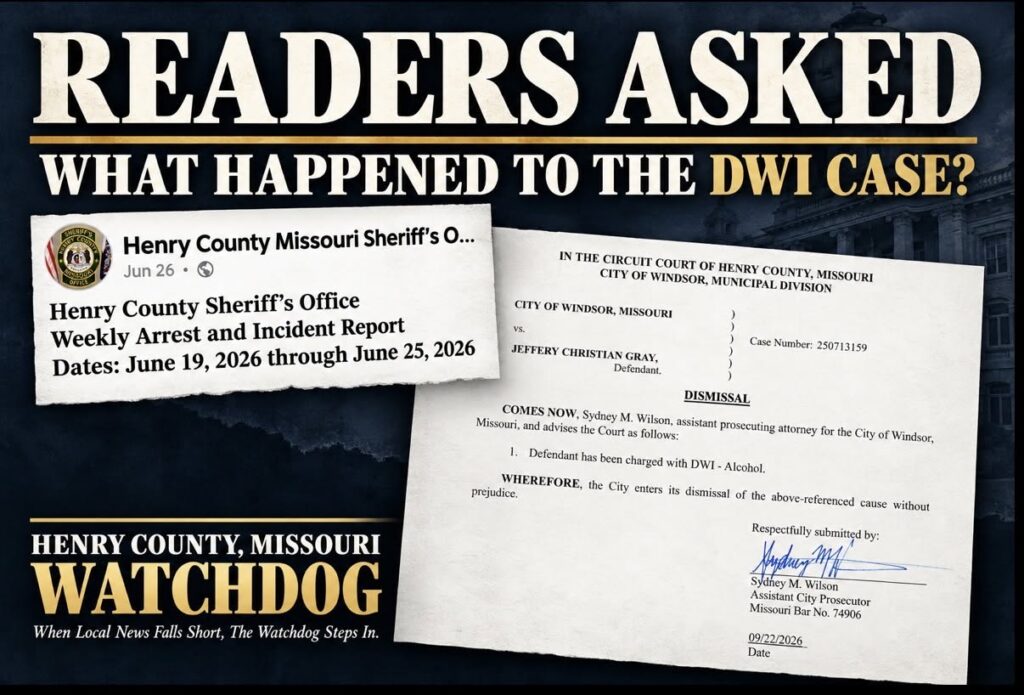
A dismissal document provided by Windsor identifies the defendant as Jeffery Christian Gray, lists case number 250713159, and states that he had been charged with “DWI – Alcohol.”
Assistant City Prosecutor Sydney M. Wilson signed the document, dated September 22, 2026. It states that the City dismissed the case “without prejudice.”
The document contains no explanation of the evidence, no alcohol-test results, and no description of an agreement with Gray. There is also no visible filing stamp establishing when the court received it.
In a separate response to the Watchdog, Windsor’s prosecutor explained:
“The case at issue, Citation No. 250713159, was dismissed pursuant to a deferred prosecution agreement.”
That distinction is important: Gray was not simply arrested and never charged. A charge was filed and subsequently dismissed.
WHAT DID THE AGREEMENT REQUIRE?
The records supplied to the Watchdog do not answer that question.
They do not establish whether Gray was required to attend classes, complete treatment, make payments, avoid further violations, or satisfy other conditions. Nor do they establish whether any obligations were completed before dismissal or remain in effect.
Without the agreement or an explanation of its terms, the Watchdog cannot responsibly characterize the dismissal and why it was dismissed.
The document identifies Windsor’s municipal prosecution office as the office handling the dismissal. It does not establish that the Henry County prosecutor participated in, directed, or influenced that decision.
THE SHERIFF’S OFFICE DECLINES TO RELEASE THE UNDERLYING RECORDS
The Watchdog also sought records concerning the stop and arrest, including body-camera footage and documentation of sobriety and alcohol testing.
In its final response, Captain Robert D. Hills said the Sheriff’s Office had reviewed Missouri’s Sunshine Law and consulted two attorneys.
The office concluded that the requested investigative, arrest, testing, and associated records were closed under § 610.105 because the case had been dismissed and finally terminated.
Hills specifically distinguished withholding records from not possessing them:
“This determination is based upon the statutory restrictions governing closed criminal records and is not intended to suggest that the underlying records do not exist or are not maintained by our office.”
Missouri law generally closes official records pertaining to a dismissed case upon final termination, subject to exceptions. The closure provisions also extend to law-enforcement records.
The Sheriff’s Office’s refusal therefore does not, by itself, establish wrongdoing or a violation of the Sunshine Law.
It does mean the Watchdog cannot independently review the withheld evidence to explain what officers observed, what testing showed, or how that evidence related to the decision to dismiss.
WAS THIS THE SAME OPPORTUNITY OTHER RESIDENTS RECEIVE?
The readers’ inquiry raises a broader question: Is this a routine outcome for similarly situated defendants in Windsor?
The records obtained so far do not answer it.
A family connection to a public official is not proof of preferential treatment. Neither is a dismissal. Determining whether someone received different treatment requires a meaningful comparison with similar cases; not an assumption based on a name or relationship.
Relevant questions include how Windsor determines eligibility for deferred prosecution, how often it offers those agreements in DWI cases, and what safeguards it uses when a case involves someone connected to a local official.
The Watchdog has not established that Gray received an opportunity denied to comparable defendants. It also has not received information demonstrating how this agreement fits Windsor’s usual practices.
WHAT THE WATCHDOG CAN REPORT
The answer to the readers’ original question is now clearer: Gray’s DWI charge was dismissed, and Windsor’s prosecutor says the dismissal resulted from a deferred prosecution agreement. However, the city of Windsor and their prosecutor will not release any information on that agreement, leaving the public unable to assess what conditions, if any, accompanied the dismissal.
What remains unknown is why that agreement was offered, what it required if anything, and whether the outcome was consistent with comparable cases.
Those are questions about the administration of justice; not a presumption that Gray was guilty or that officials acted improperly.
The available records explain how the prosecution ended. They do not yet explain the decision behind that outcome.
Henry County, Missouri Watchdog
When Local News Falls Short, The Watchdog Steps In